Why Does My Voice Shake When I’m Nervous? What’s Happening and What Helps

Why Does My Voice Shake When I’m Nervous? What’s Happening and What Helps
← Back to Pureflow

Why Does My Voice Shake When I’m Nervous? What’s Happening and What Helps

Francie La Flow with a hand on her chest and eyes closed among pink flowers

You know exactly what you want to say. Then you open your mouth and the voice that comes out is wobbly and thin, a little higher than yours, and now you’re listening to it shake while you try to keep talking. In the meeting. On the call. Introducing yourself in a circle. Saying the one thing you’ve been rehearsing for days…

By the end of this page you’ll know what’s happening in your body when your voice shakes, why the usual tips often don’t touch it, and you’ll have a few small practices that help it steady, starting with one you can do right now.

Try this first (about 90 seconds)

Feel both feet on the floor. Let your teeth come apart and your shoulders drop. Breathe in through your nose, then breathe out through softly pursed lips, like you’re cooling a cup of tea, slower than the in-breath. Do that three times. Now put a hand on your chest and hum one easy, low-ish note for a whole breath. Feel the buzz under your hand. Then say your first sentence out loud, slowly. Anything a little steadier?

Here’s something I don’t say often enough. When I’m teaching, I feel completely at home in my voice. When I’m invited to share my voice as a performer, even today, it can go shaky for the first few moments, before I drop into the flow. A little voice pipes up: what if I’m not good enough, what if they don’t like it, what if people get up and leave the room?

And after years of practice, my voice can still shut down when I need to express a boundary. So if yours shakes, you’re in very good company.

A shaking voice is one of the clearest ways your nervous system speaks through your throat. I wrote the long version of that story, with all four ways a voice protects you, in Trauma and the Voice: Why Your Voice Shuts Down. This page zooms in on the shake.

Why does my voice shake when I’m nervous?

Your voice shakes when you’re nervous because your body has switched into protection. Your breath moves up high into your chest and gets short, the small muscles around your voice box tighten, and adrenaline adds a tremble to your hands, your knees and your voice. There’s less steady air under the sound, so it wobbles.

Your voice rides on your breath. Your vocal folds vibrate as air moves past them, so a steady stream of breath gives you a steady sound. When nerves make the breath shallow and uneven, the sound follows it.

Here’s what tends to happen, all at once, in about two seconds:

  • Your breath climbs. It moves out of your belly and ribs and up into your upper chest, quick and shallow.
  • Your throat braces. The muscles around your larynx tighten, and your pitch often creeps up.
  • Your jaw and tongue grip. They hold on, which leaves less space for sound.
  • Adrenaline arrives. Your heart speeds up and your muscles get ready to move, and a little of that energy comes out as a tremble.
  • Your mouth goes dry. Which makes speaking feel even harder!

The nerves that move your vocal folds are branches of the vagus nerve, which plays a big part in how your body shifts between feeling on guard and feeling settled. So your voice changes fast with your state, often before you’ve even noticed you’re nervous. I wrote more about that in my guide to the vagus nerve and your voice.

Your body is getting you ready to handle something. The shake is that readiness, with nowhere to go.

Is a shaky voice a sign of anxiety?

A shaky voice is one of the most common ways anxiety shows up in the body, and it happens to experienced teachers, performers and speakers too. It tells you your system has noticed pressure. It says nothing about your worth, or about whether what you have to say matters.

For a lot of us, the voice shakes most in very particular moments: when the subject turns to you, when someone is watching or recording, when you have to say no, or when someone in charge is listening. Those moments carry old information for your body, from every earlier time when speaking up felt risky.

Which of these sounds like you?

Most of us have a go-to protection response, and which one shows up depends on the situation. Pick the one that feels most familiar, then jump to the practice that helps it most.

  • My voice goes thin and wobbly, then disappears. Sometimes my mind goes blank. That’s the freeze voice. Start with humming with a hand on your chest.
  • My voice climbs higher and softer, and my sentences end like questions. You’re keeping everyone comfortable while you speak. That’s the fawn voice, Pete Walker’s name for it. Start with landing the end of your sentence.
  • I speed up, rush and run out of breath halfway through. You want it over with before anyone can react. That’s the flight voice. Start with lengthening your exhale.
  • My voice shakes and pushes at the same time, too loud and tight. You’re bracing to make sure you get heard. That’s the fight voice. Start with shaking it out first.

The insight lives in your head. The shake lives in your body.

If you’ve already tried the usual advice, practice more, take a deep breath, picture the audience somewhere else, and your voice still shakes when it counts, nothing is wrong with you.

You can understand exactly why it happens, and it will still happen. The understanding lives in your head. The shake lives in your body, and your body learns that speaking is safe through experience: breath, sound and small moments of being heard, again and again. That’s why every practice below happens out loud.

One big deep breath can backfire, too. Gulping air up into your chest often adds to the tension. A long, slow out-breath is what helps your body settle.
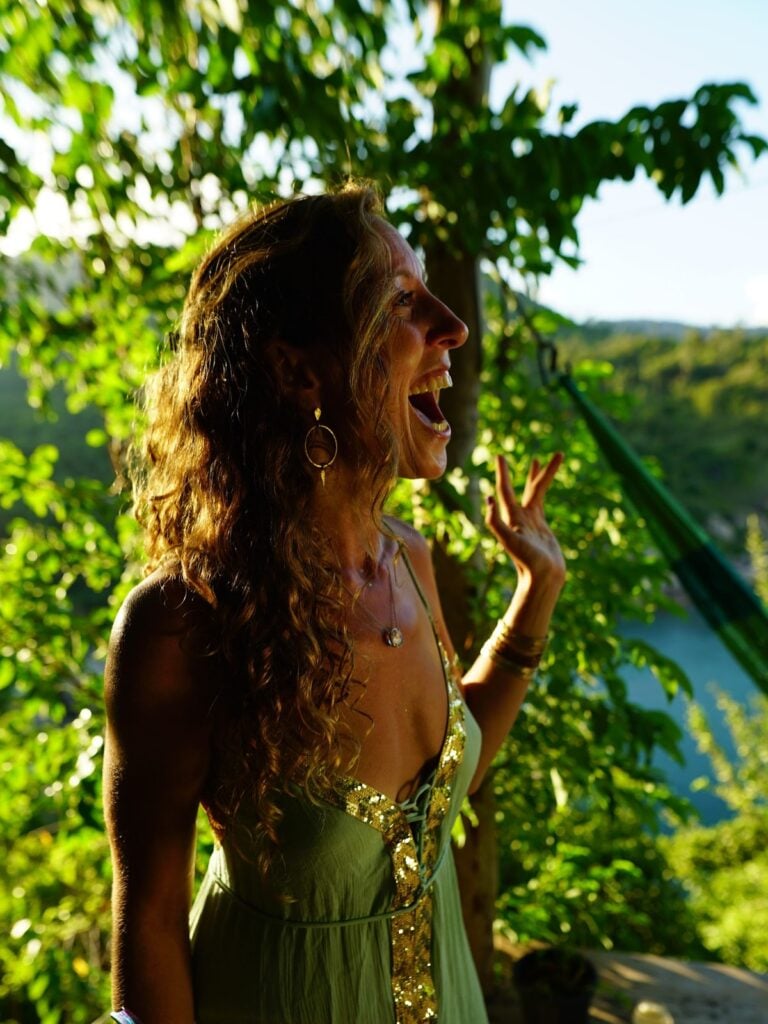
Francie La Flow singing outdoors in a green dress, mouth open mid-song

How to stop your voice shaking

Trying to hold a shaky voice still usually tightens it even more. What helps is giving your body more breath, more ground and a little more safety, before you speak and while you’re speaking. These seven practices take between thirty seconds and a few minutes each.

1. Shake it out first

Before the call or the meeting, find a private corner and let the extra energy move somewhere other than your voice. Shake your hands, your arms, then your whole body for thirty seconds. Bounce on your heels. Finish with a big audible sigh. It looks silly and it works beautifully!

2. Lengthen your exhale

Breathe in through your nose for a count of four, then out through your mouth for a count of six or eight. Your out-breath is where your voice lives, so a long, easy exhale gives your sound something steady to ride on. Try it three times before you speak, and take one slow breath again before you answer a question.

3. Hum with a hand on your chest

Hum quietly on any comfortable note for thirty seconds, with a hand resting on your chest. Humming lengthens your exhale and gently vibrates your throat and chest, and feeling that buzz under your hand gives your attention somewhere warm to land. If you love a mantra, chant HAM, the seed sound of the throat chakra, which I share in my post on how to open a blocked throat chakra.

4. Feel your feet and slow your first sentence

Press your feet into the floor and feel the chair holding you. Then say your first sentence a little slower than feels natural. The first few words are usually the shakiest, and once they’re out, your body often starts to settle.

5. Land the end of your sentence

If your voice climbs and your sentences lift into questions, practice letting the pitch come down at the end. Say one true sentence out loud, like “I’d love to share my idea,” and let the last word drop and land. No apology before it, no softening after it. Just let it sit there.

6. Let it shake, and keep going

Sometimes the kindest move is to stop fighting the shake. You can even name it: “I’m a little nervous, so my voice might wobble.” Dan Siegel calls this name it to tame it, and it often takes some of the charge out of the moment.

It helps to know that your listeners hear far less than you do. Psychologists call this the illusion of transparency: when you’re nervous, you tend to overestimate how much of it other people can see and hear.

7. Build capacity in small doses

Your voice steadies each time your body speaks and stays safe. So practice where the stakes are low. Hum or read a page out loud at home. Then speak to one kind person. Then a few people. Record a voice note and listen back with curiosity. Each small dose widens what your body can hold.

You’ll find the shaky voice alongside seven other patterns in Common Voice Problems, and How to Work With Each One.
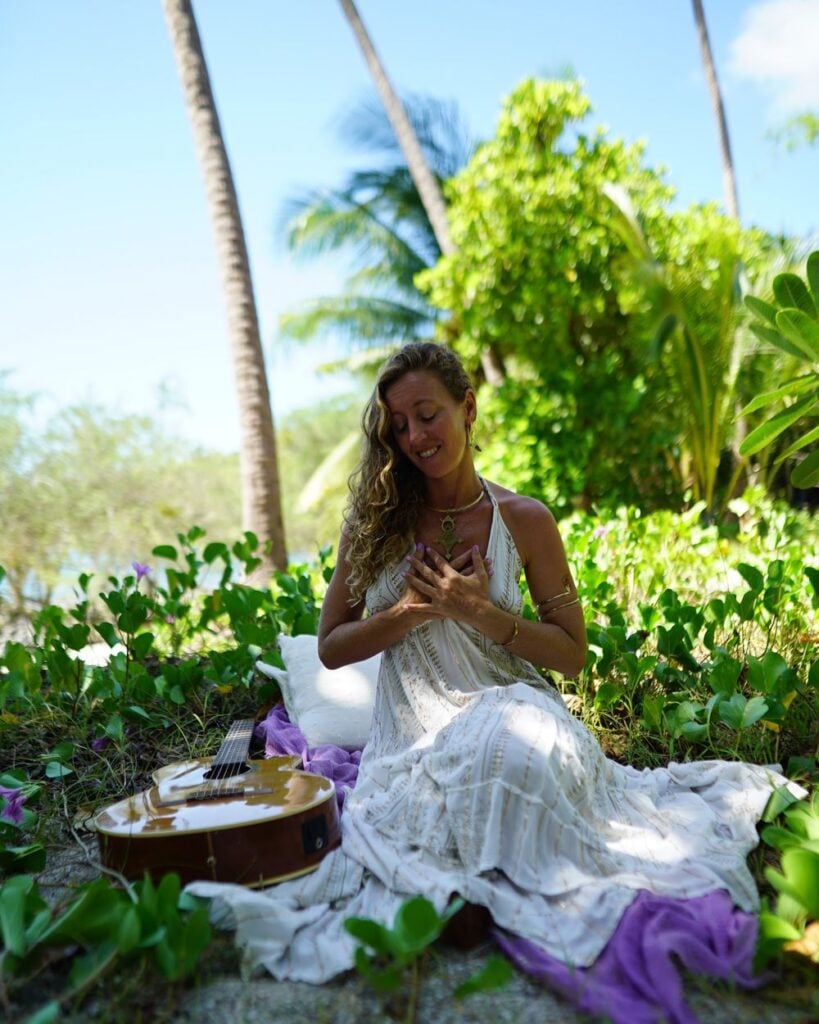
Francie La Flow sitting in meditation with her hands at her chest beside her guitar

When to see a doctor about a shaky voice

A voice that shakes with nerves and settles once you calm down is your nervous system doing its job. Please see a doctor, an ENT or a voice specialist if your voice shakes when you feel calm too, if the tremor keeps getting worse, if you notice shaking in your head or hands as well, or if you have hoarseness that lasts more than two or three weeks or pain when you speak or swallow. A voice tremor that doesn’t settle can have physical causes, and it deserves a proper check. Everything on this page sits alongside medical care.

Shaky voice: your questions

Why does my voice shake when I’m nervous?

When you feel under pressure, your breath moves up into your chest and gets shallow, the muscles around your voice box tighten, and adrenaline adds a tremble. Your voice rides on your breath, so with less steady air under the sound, it wobbles. It’s your nervous system getting you ready to handle something.

How do I stop my voice from shaking when I speak?

Give your body more breath and more ground. Shake out your hands and arms beforehand, breathe out slowly for longer than you breathe in, hum quietly with a hand on your chest, feel your feet, and say your first sentence slowly. Then build capacity in small doses, starting with one safe person.

Is a shaky voice a sign of anxiety?

A shaky voice is one of the most common ways anxiety shows up in the body, and it happens to experienced speakers too. It tells you your system has noticed pressure. If your voice also shakes when you feel calm, see a doctor to rule out a physical cause.

Can other people hear my voice shaking?

Usually much less than you think. Psychologists call it the illusion of transparency: nervous speakers tend to overestimate how much of their nervousness other people can see and hear. Naming it out loud, like “I’m a little nervous,” often helps it settle.

When should I see a doctor about a shaky voice?

See a doctor, an ENT or a voice specialist if your voice shakes when you are calm, if the shaking keeps getting worse, if your head or hands shake too, or if you have hoarseness for more than two or three weeks or pain when speaking or swallowing.

You find your voice by using it

A shaky voice is a voice that showed up anyway. Every time you speak while it wobbles, and nothing bad happens, your body files that away as evidence that speaking is safe. That’s how it steadies, one small brave sentence at a time.

When does your voice shake the most for you? I’d love to hear.

Want your voice to feel steadier when it counts?

Start with my free practices: a Permission to Sing meditation, a vocal care ritual and a playlist to sing along with. Nobody hears you but you, so it’s the easiest place to begin.

Send me the free practices
Francie La Flow, voice healer and somatic guide

About Francie

Francie La Flow is a voice healer, somatic guide and bhakti musician based in Ubud, Bali. For more than 15 years she has helped people come home to their voices through yoga, sound, singing circles, retreats and 1:1 sessions.


Why Your Voice Changes Depending on Who You’re With (and Where You Are)

Why Your Voice Changes Depending on Who You’re With (and Where You Are)

← Back to Pureflow

Why Your Voice Changes Depending on Who You’re With (and Where You Are)

Francie La Flow laughing and playing guitar in front of a carved wooden door

Full and easy and laughing with your closest friend. A little smaller and more careful at the family dinner. Somehow flat the second you press record. And then someone in a group turns to you and asks what you think, and your voice is just… gone.

By the end of this page you’ll know which rooms shrink your voice and why, and you’ll have a few small ways to bring more of it with you into the next one.

Try this before your next hard room (about 90 seconds)

Picture a room where your voice usually gets small. Let your teeth come apart and your shoulders drop. Breathe in through your nose, then let the breath fall out of your mouth, slower than it came in. Do that three times. Now close your eyes and hum one easy note for a whole breath. Then picture that room again. Anything a little softer in your throat?

It’s the same throat and the same person, with a completely different sound.

I notice this all the time in my work. Someone will be talking to me in a warm, clear voice, and then the conversation shifts and their voice shifts with it. When I gently point it out, they’re often surprised. Very few of us hear it happening. Your voice reveals it all, though. It shows exactly where you feel free and where you’re still holding back.

So let’s look at why it happens, the rooms where it tends to happen most, and how to bring more of your voice with you wherever you go.

Your voice is always reading the room

Your nervous system is quietly scanning for safety every moment of the day. It’s looking at faces, listening to tone, remembering what happened the last time you were in a situation like this one. And your voice responds to what it finds.

Branches of the vagus nerve supply the muscles of your voice box, and your breath, jaw, tongue and throat all shift depending on how safe you feel. So when a room feels safe, your voice tends to flow. When a room carries some old memory of danger, judgement or not being heard, your voice adjusts to protect you. It might get quieter, faster, flatter, higher or careful with every word.

For most of us, needing to belong ran the show from a very young age. We learned to bend how we speak and express ourselves into whatever kept us accepted. That wisdom is still living in your body, and it switches on in the rooms that remind it of the old ones.

So if you’ve done the therapy, the yoga, the meditation, maybe a voice course or two, and your voice still goes small the minute you walk into your parents’ house, nothing is wrong with you. You can understand exactly why it happens and it will still happen. The insight lives in your head. The block lives in your body. Your body learns that a room is safe through experience, one breath and one small true sentence at a time, and that’s what the practices further down are for.

Which of these sounds like you?

Most of us have a go-to protection response, and which one shows up depends on the room you’re in. Pick the one that feels most familiar, then jump to the practice that helps it most.

  • My words get stuck. The push and pull starts inside: should I say it? Should I stay quiet? You go back and forth, you go blank when you’re put on the spot, and you think of the perfect answer an hour later. That’s the freeze voice. Start with practicing with one kind witness.
  • My voice goes small and careful, especially with family or anyone in charge. You keep everyone comfortable and your own voice comes last. That’s the fawn voice, Pete Walker’s name for it. Start with your voice map.
  • I talk fast and check every word as it leaves my mouth. You rush to get it over with before anyone can react. That’s the flight voice. Start with carrying one quality into a harder room.
  • My voice pushes or gets sharp when there’s feedback or conflict. You brace to make sure you get heard. That’s the fight voice. Start with softening before you speak.

These four also hide in the way we talk, so smoothly that they can sound like personality. Two of the most common belong mostly to the fawn family:

  • The minimizing voice: “I just wanted to…”, “This is probably nothing, but…”, “Only if you have time.” Making what you need smaller before anyone else can say no. When it tips into shrinking and shame, there’s some freeze in it too.
  • The self-deprecating voice: the joke at your own expense, landing first so nobody else can. It gets a laugh, and it keeps you from being taken fully seriously. Sometimes it’s flight in disguise, a quick exit from a moment that feels too exposed.

If you recognize yourself here, you’re in good company. These are clever, very human ways of staying safe and staying liked.

I go through all four, with a practice for each, in trauma and the voice: how the nervous system speaks through the throat.

Two-minute quiz

Which voice shows up for you? Ten quick questions show your protective voice, what it does to your breath, jaw and throat, and the practice that helps it first.

Take the throat chakra quiz
Francie La Flow with her eyes closed and a hand at her forehead beside her guitar

The rooms where your voice changes most

These are the patterns I see come up again and again, in sessions and in classes. See which ones you recognize.

When the subject turns to you

Plenty of people speak with ease about their work, their travels or the people they care for. Then the topic becomes their own feelings, fears or dreams, and the voice softens, drops and gets smaller, sometimes in the middle of a sentence. Talking about yourself can feel like the most exposed room of all.

When your voice is for others, and when it’s for you

Many teachers, healers, coaches and parents have a voice that flows beautifully when it’s helping someone else. Guiding a meditation, explaining a pose, comforting a friend. Then it’s time to share their own creative work, their own story or their own needs, and the same voice stalls. A voice that’s always been useful can forget it’s allowed to be expressive for its own sake.

When someone is watching or recording

The camera is a big one. A voice that’s lively and magnetic in person can go flat the moment you press record, or freeze when you’re asked to speak to an imagined audience. Being watched, and especially being judged later on a screen, can feel very different to talking with someone who’s right there with you.

When you choose the moment, and when you’re put on the spot

Lots of people can speak up when they decide the moment is right, and go completely blank when they’re called on, assessed or expected to get it perfect. Perfectionism rushes in, the body shuts down, and the words vanish.

Alone, with one witness, or in a group

For many people, the voice is freest when they’re alone, often with their eyes closed. Some people feel safest singing in a big group, where their voice blends in. And for a lot of us, the edge is one person listening closely. Being seen while making sound is its own kind of vulnerable.

At home, with family

Family can switch on a very old voice. If being quiet was the safest thing in the house you grew up in, a smaller, more careful voice might come back the moment you walk through the door, even decades later.

With authority, feedback or conflict

Someone in charge, a sharp tone, a piece of criticism, a moment where you need to say no. In these rooms, voices tend to go one of two ways: they push and get defensive, or they scramble, go quiet and disappear. Sometimes the whole body freezes and the word no just won’t come.

With peers who seem more confident

Colleagues, a new group, people who sound very sure of themselves. Here the question is less about power and more about belonging. Will I sound smart enough? Will they like me? You might rehearse a sentence until the moment passes, wait for a gap that never comes, or over-explain once you finally speak. Some people are completely at ease when the floor is handed to them, like giving a talk or teaching a class, and struggle when they have to take the floor themselves, in a fast conversation where nobody makes space.

When money or love is on the line

Saying your price. Asking for a raise. Telling someone what you need, or that you love them. These moments cross every kind of room, because they touch your sense of worth. This is where the minimizing voice loves to step in. You might drop your price before anyone has blinked, rush through the number, add a discount nobody asked for, or say “I love you” as a question. Your body is asking an old question: am I allowed to want this much?

When there’s no space

When life is overflowing, with no room in your schedule, your home or your own body, the voice often goes too. In the yogic tradition, the element of the throat chakra is space. It makes sense that expression is often the first thing to go when we have none.

Speed, scanning and checking your words

Running through many of these rooms is another pattern: talking fast, scanning faces for reactions, and checking every word as it leaves your mouth. Checking every word is often a quiet way of protecting yourself, and it’s exhausting!

Francie La Flow laughing under palm leaves in a purple kaftan

Personal vs professional: which one is harder for you?

Some people find work easy and home hard. Others are completely themselves with family and go quiet the minute they walk into the office. Neither one means you’re doing it wrong. It just shows where your nervous system learned to be careful. Different relationships wake up different histories: work might feel structured and clear while family carries your oldest roles, or home might feel safe while hierarchy at work echoes a strict parent or teacher.

The voice map below is a lovely way to see your own pattern. Mix personal and professional rooms, and notice which side your voice goes quiet on.

How to bring more of your voice into every room

The goal here is to widen your capacity, so more of you gets to be in more rooms. You get to keep all your voices. You’re just letting the freest one come along more often.

1. Notice, with curiosity

Start by noticing when your voice changes, and meet it with curiosity. Every shift is information about where you feel safe and where you’re still learning to.

2. Make a voice map

Grab a journal and list eight or ten situations from your week: a close friend, your partner, a parent, your boss, a video call, a group, speaking to a stranger, singing alone. Next to each one, rate how free your voice feels from one to ten, and note what happens in your body.

Look for your freest voice. Where does it live? What’s true about that room? Maybe you’re relaxed, unhurried, not being watched, or with someone who delights in you.

3. Carry one quality into a harder room

Pick one quality from your freest room and bring it into a harder one. If your voice is freest with your eyes closed, hum with your eyes closed for a minute before a big call. If it’s freest when you’re unhurried, build in a slow breath before you answer a question. Small bridges make a big difference.

4. Soften before you speak

Before a room that usually shrinks your voice, soften your jaw, drop your shoulders, lengthen your exhale and feel your feet. A phrase I love to offer here is: “I am safe to soften. I am safe to express.”

5. Practice with one kind witness

If one person listening is your edge, practice there. Ask a trusted friend to listen while you read a paragraph aloud, sing a verse, or say something true. Let them just receive it. Each time, your body learns that being heard can be safe.

6. Create space

If your voice disappears when life is full, give it a little space back. That might be five quiet minutes before a meeting, a walk before a hard conversation, or a morning hum before the house wakes up. Letting your sound take up space starts with giving yourself some.

You find your voice by using it

Your voice is already here, in every room, doing its best to keep you safe. And the more you use it, gently, in small doses, in rooms that feel a little safer each time, the more of you comes through.

After years of this work, my own voice still tightens in certain moments: when I need to say a boundary out loud, and when it comes to love and money, like saying my prices with confidence and charging what my work is truly worth. That’s the edge I’m growing right now, and I’m practicing it the same way I teach it. I notice the tightness, I breathe, I let my voice drop, and I say the number anyway. If I can learn to come back to my voice, so can you.

Rising Resonance · one to one

Ready to sound like yourself in every room? Rising Resonance is my three-month container for somatic voice and expression. We go to the root of where your voice learned to change shape, and we practice bringing your full voice into the relationships and rooms that matter to you, at work and at home.

See Rising Resonance

Not sure yet? Book a free Resonance Call, twenty to thirty minutes with me.

You can also find this pattern alongside seven others in Common Voice Problems, and How to Work With Each One.

Questions people ask me

Why does my voice change around certain people?

Your nervous system reads every person differently, based on your history with power, belonging and safety. With people who feel safe, your throat relaxes and your voice is full. With people who feel risky, your body shifts into protection, and your voice gets smaller, higher, faster or louder to match.

Why does my voice get higher when I talk to some people?

A higher, softer voice is often the fawn response: your body trying to sound pleasant and unthreatening so you stay connected. It shows up most with authority figures, new people and people you really want to like you. Breathing lower into your belly and letting your first sentence drop in pitch can help.

Why am I afraid to speak up for myself?

Usually because, somewhere along the way, speaking up for yourself didn’t feel safe. Maybe it led to conflict, punishment or someone pulling away. Your body learned to stay quiet to protect the relationship. That pattern can change, gently, with practice and support.

Why do I make myself small or put myself down when I talk?

Minimizing (“I just…”, “it’s probably nothing”) and self-deprecating jokes are quiet forms of protection. They lower the stakes before anyone can judge or refuse you. Start by noticing them. Then try saying one request or one price without the softener, and let the silence after it be okay.

Why am I confident at work but not at home (or the other way around)?

Different relationships wake up different histories. Work might feel structured and clear, while family carries your oldest roles. Or home might feel safe while hierarchy at work echoes a strict parent or teacher. Noticing where your voice shrinks is the first step to bringing more of it with you.

Can this really change?

Yes! Your nervous system keeps learning your whole life. Most people notice small shifts within a few weeks of practice: an easier breath, a steadier first sentence, a moment where your voice stays when it would usually leave. Those moments add up.

Want your voice to come with you into more rooms?

Start with my free practices: a Permission to Sing meditation, a vocal care ritual and a playlist to sing along with. Nobody hears you but you, so it’s the easiest room of all to begin in.

Send me the free practices

Francie La Flow, voice healer and somatic guide

About Francie

Francie La Flow is a voice healer, somatic guide and bhakti musician based in Ubud, Bali. For more than 15 years she has helped people come home to their voices through yoga, sound, singing circles, retreats and 1:1 sessions.
Common Voice Problems, and How to Work With Each One

Common Voice Problems, and How to Work With Each One

← Back to Pureflow

Common Voice Problems, and How to Work With Each One

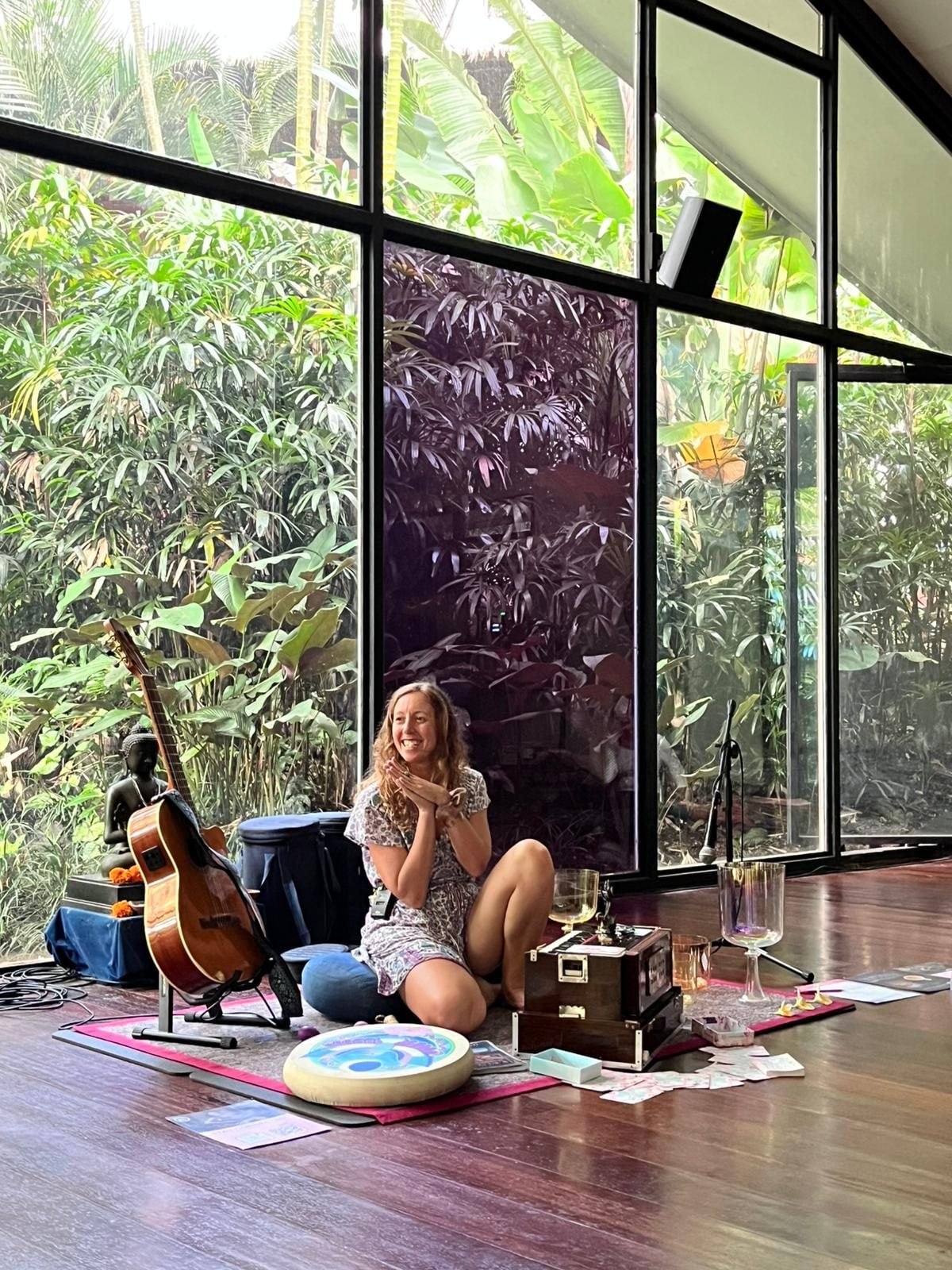
Francie La Flow teaching a Vocal Flow class at The Yoga Barn, with guitar, harmonium and crystal bowls

Why does my voice shake when I’m nervous? Why can’t I reach the high notes? Why does my throat get so dry when I sing? Why do I sound like a completely different person on the phone to my mother?

If one of those made you wince a little, this page is for you. Every one of these common voice problems has a gentle way through, and by the end you’ll know what’s usually going on underneath yours and how to start working with it today.

Try this first (about 90 seconds)

Let your jaw soften and your teeth come apart. Breathe in for four and out for six, twice. Then hum one easy, low note with a hand on your chest for a whole breath out, and feel the buzz under your hand. Do it three times. Most of the problems below start to ease with some version of this: a slower exhale and a voice that can feel its own vibration.

People ask me about their voices all the time, after classes, in circles and in sessions. Each person usually asks as if they’re the only one. They never are!

If you’ve tried the lessons, the tea with honey and the exercises from YouTube, and the same problem keeps coming back, it’s usually because your voice is listening to how safe your body feels. The insight lives in your head. The habit lives in your body. So every way through below starts with your breath and your body, and then moves to your notes and your words.

Which of these sounds like you?

Your voice has a go-to way of protecting you, and it often shows up as one of these. Pick the one that feels most familiar and jump straight to it.

Singing and teaching voices get their own sections too: a voice that shakes when you’re nervous, a dry throat after singing, a voice that changes around certain people and hoarseness after long teaching days.

A few things hold true for all of them. Your voice lives in your body, and it’s always listening to how safe you feel. So the work starts with safety in the body, then the breath, then sound. My favourite reminder is to relax into sound instead of reaching for it. And the aim is to build: more strength, more resilience, more range, and more capacity for your voice to come with you into every part of your life.

1. Your voice goes quiet or shaky when you’re nervous

What’s going on. When your nervous system senses pressure, your breath moves up high into your chest and gets shallow, and your throat and jaw tighten. There’s less steady air under your voice, and adrenaline adds a tremble. Going quiet is protection, and I wrote about the four ways a voice protects you in Trauma and the Voice. One thing I notice often is a voice that’s full and warm about work or other people, then drops and softens the moment the subject turns to the person’s own feelings.

How to work with it. Before you speak, lengthen your exhale: in for four, out for six or eight. Feel your feet on the floor. Hum quietly with a hand on your chest for thirty seconds before the call or the meeting. Then build capacity in small steps, first speaking with one safe person, then a few. A shaky voice is allowed. Each time your body speaks and stays safe, it gets a little steadier.

2. You can’t reach the high notes, or you strain

What’s going on. To sing higher, your vocal folds stretch longer and thinner and vibrate faster. Most of us try to carry our heavy, speaking-style voice up with more volume and effort, and the chin lifts, the jaw clenches and the throat squeezes. A high note can also feel like a small risk, so the body braces.

How to work with it. Warm up from the comfortable middle of your range and move up slowly. Use gentle sirens on “ng” or “oo”, and lip trills. Sing high passages lighter and quieter first, and let your voice change colour as it climbs. Range expands over weeks, one easy note at a time. If singing hurts, or you notice hoarseness or any loss of range lasting more than two or three weeks, please see an ENT doctor or a speech therapist who specialises in voice.

3. Your throat gets dry and you cough after singing

What’s going on. A student asked me this recently, and it’s so common. Fast vibration and lots of airflow can dry the thin, moist layer that helps your vocal folds move smoothly. Breathing through your mouth, not drinking enough water (the heat here in Bali and air conditioning both dry you out), singing louder or longer than you need to, and clearing your throat all add to it.

How to work with it. Drink water steadily for hours before you sing, and breathe in some warm steam. Breathe through your nose when you can. Take short vocal rests. Try humming through a straw to warm up. When the tickle comes, take a sip or a gentle swallow and let the clearing go. Please see an ENT doctor or a voice-specialised speech therapist if hoarseness, pain or loss of range lasts more than two or three weeks, and go straight away if you ever see blood or lose your voice suddenly.

Francie La Flow with her hand on her chest, eyes closed, smiling in the sun

4. Your voice changes around certain people

What’s going on. Your nervous system reads every room. Around family, a careful, smaller voice from long ago can switch back on. With someone in authority, or when you’re receiving feedback, you might scramble or get defensive. On camera, a voice that’s lively in person can go flat. And many teachers and healers find their voice flows freely when it’s helping someone else, then stalls when it’s time to express themselves.

How to work with it. Start by noticing, with gentle curiosity. Make a little map of where your voice feels freest and where it feels smallest. Then bring one quality from your freest voice into a harder room: a soft jaw, a hum beforehand, a slow breath. A phrase I love to offer here is “I am safe to soften. I am safe to express.”

5. You talk too fast

What’s going on. This is the rushed voice, the flight response. The body feels urgency, so the words try to outrun the discomfort. Often it comes with scanning the room and checking every word as it leaves your mouth, and it’s exhausting.

How to work with it. Ground through your feet. Take slow breaths through your nose. Build pauses in on purpose: finish a sentence, breathe, then begin the next one. A long “sss” exhale before you start is lovely. For practice, read one paragraph out loud at half speed each day. And learn your early signs, so you catch the rush as it begins.

6. Upspeak and an apologetic tone

What’s going on. This is the pleasing voice. Statements rise at the end like questions, sentences start with “sorry” or “I just”, and your tone softens so nobody could possibly disagree. It keeps connection feeling safe, and it costs you your own expression. The worthiness wound often sits right underneath it.

How to work with it. Practice simple truth statements, letting the pitch come down at the end. Hum low in your chest to feel your own resonance, and sit or stand tall. Say one grounded sentence a day with no “sorry” in front of it and no laugh after it. For one day, count how many times you apologise. Awareness alone starts to shift it.

Francie La Flow playing guitar with her eyes closed in a purple dress

7. You freeze when you’re called on

What’s going on. So many people find their voice works when they choose the moment to speak, and closes when they’re picked, put on the spot or feel assessed. The mind goes blank, the throat tightens and perfectionism rushes in. It’s the freeze response, and it’s intelligent protection.

How to work with it. Warm your body before group settings with a little movement, so it’s less likely to lock. When you’re called on, give yourself one breath and a simple phrase like “Let me take a breath with that.” Practice being put on the spot in low-stakes ways, with a friend who asks you surprise questions. Keep the doses small, and celebrate every one.

8. Hoarseness after long teaching days

What’s going on. Teachers, coaches and space holders use their voices for hours, often over music or background noise, pushing from the throat, with little water and no rest. A voice that’s always in service rarely gets a warm-up or a break.

How to work with it. Warm up for a few minutes before you teach, with hums and lip trills. Let your breath carry the sound and feel the buzz in your face, so the throat does less of the work. Turn the music down so you can speak at a comfortable volume, and use a microphone in a big room. Build quiet moments into your class, sip water between sections, and breathe in warm steam afterwards. If hoarseness lasts more than two or three weeks, or you notice pain, blood or sudden voice loss, please see an ENT doctor or a voice-specialised speech therapist.

Building a stronger, more resilient voice

Every one of these gets easier the same way: gentle practice, little and often, in a body that feels safe enough to try. Strength grows through use. Range grows as your body trusts it’s allowed to go there. Capacity grows each time you let a little more of yourself be heard and nothing bad happens. That’s what I mean by embodied resonance: a voice that feels at home in your body, wherever you are.

It’s one of my favourite things to remind people: you find your voice by using it.

If you’d love to work on your voice with me, Rising Resonance is my online 1:1 mentorship: six weeks, $1,497, where we find your patterns together and build strength, range and capacity at a pace your nervous system can say yes to.

Want your voice to feel steady and at home in you, wherever you are?

Start with my free voice practices: a vocal care ritual to warm up, a Permission to Sing meditation and a playlist to sing along with.

Send me the free practices

Francie La Flow, voice healer and somatic guide

About Francie

Francie La Flow is a voice healer, somatic guide and bhakti musician based in Ubud, Bali. For more than 15 years she has helped people come home to their voices through yoga, sound, singing circles, retreats and 1:1 sessions.

Voice Liberation Techniques: 7 Gentle Practices to Free a Voice That Holds Back

Voice Liberation Techniques: 7 Gentle Practices to Free a Voice That Holds Back

← Back to Pureflow

Voice Liberation Techniques: 7 Gentle Practices to Free a Voice That Holds Back

A woman dancing freely with a flowing scarf at the water's edge at sunset

The words you meant to say are still sitting in your throat long after the moment has passed. Your voice trails off, or rushes, or apologises before it even starts, or vanishes completely when the stakes feel high. You know exactly what you want to say. Your voice just won’t come with you yet.

By the end of this page you’ll have seven gentle voice liberation techniques you can do at home in about five minutes, a one-week plan to string them together, and a way to tell which ones your voice needs most.

Try this first (about 90 seconds)

Breathe in through your nose, then let it fall out of your mouth as a sigh you can hear. Three times, a little dramatic. Then close your lips, let your teeth come apart and hum one low, easy note, feeling the buzz in your lips and chest. Hum it twice more. Now say one short true sentence out loud, like “I need a minute”, and let the pitch come down at the end. Notice your throat. A little freer?

If you’ve done the therapy, the yoga, the meditation, maybe even singing lessons, and your voice still holds back when it counts, nothing is broken. The insight lives in your head. The holding lives in your body. Your voice loosens when your body gets a new experience of making sound and staying safe, again and again, and that’s exactly what these seven practices give it.

Voice liberation is what I call the slow, gentle process of freeing a voice that has learned to hold back. It might be the voice that trails off at the end of a sentence, the one that rushes to get it over with, the one that apologises before it speaks, or the one that disappears altogether when the stakes feel high.

Here are seven of the practices I come back to most, in my own life and with the people I work with. None of them require you to be a singer. All of them can be done at home, in about five minutes, with nobody listening.

Which of these sounds like you?

Most of us have a go-to protection response, and which one shows up depends on the room. I go through all four in detail in Trauma and the Voice. Pick the one that feels most familiar and start with the practice that helps it most.

  • My voice disappears when the stakes feel high. You go blank, quiet or frozen. That’s the stuck voice. Start with low, gentle humming.
  • I rush to get it over with. You talk fast and fill every silence. That’s the rushed voice. Start with the audible sigh.
  • My voice pushes, gets loud or tight. You brace to make sure you’re heard. That’s the pushed voice. Start with releasing your jaw and tongue.
  • I soften every truth and end on a question. You keep everyone comfortable. That’s the pleasing voice. Start with one grounded sentence.

First, a word about force

When we want our voice to be freer, the instinct is usually to push. Be louder, be braver, just say it!

For a voice that has been protecting you, pushing tends to make the protection stronger. Your voice heals through safety, warmth and presence, in small doses, over time. So every technique below is designed to be gentle. If something feels like too much, do less of it. Less is still practice.

Keep your pattern in mind as you read, and I’ll point out which practices tend to help which.

1. Notice your state before you speak

The simplest technique of all, and the one everything else rests on.

Before you speak, sing, send the voice note or step into the meeting, pause for one breath and notice. How does your throat feel? Your jaw? Is your breath high in your chest or low in your belly? Place a hand on your throat or your heart if that helps you feel it.

You don’t need to change anything. Noticing is the practice. Over time, noticing gives you a tiny gap between the old reflex and your response, and that gap is where choice lives.

2. The audible sigh

Breathe in through your nose, then let the breath fall out of your mouth with a sigh you can hear. Let it be a little dramatic. Do it three times.

A long, slow exhale is one of the quickest ways to invite your body toward rest, because your heart rate naturally slows a little as you breathe out. Adding sound to the exhale gently wakes up the voice at the same time.

This one is especially lovely if your voice tends to rush. Try making the exhale longer than the inhale, or exhaling on a long “sss” like a slow leak.

Francie La Flow reaching both arms up to the sky in a purple kaftan

3. Low, gentle humming

Close your lips, relax your jaw so your teeth are slightly apart, and hum on a comfortable low note. Feel the buzz in your lips, your face, your chest. Move the hum around a little: a bit lower, a bit higher, back home again.

Humming is voice work with the training wheels on. It’s quiet, it’s private, you can do it while you cook, and it lets you feel your own vibration without the exposure of opening your mouth. If your voice tends to push, keep it soft and low. If it tends to freeze, a warm hum with your hand on your chest is a beautiful place to start.

4. Release the jaw and tongue

So much holding lives in the jaw. Try this:

  1. Gently massage the hinge of your jaw, just in front of your ears.
  2. Let your mouth fall open a little, as if you’re about to yawn, and let a yawn happen if it wants to.
  3. Stick your tongue all the way out and down toward your chin, then let it relax back in.
  4. Sigh out an easy “ahhh” with your jaw loose.

It feels silly, and that’s part of the medicine. A loose, slightly goofy face makes it much harder for the throat to stay braced.

5. Permission statements

One of the most powerful practices I know is to actively give yourself permission. To heal, we need to feel safe, and permission is one of the ways we make ourselves safe from the inside.

Say these out loud, or write your own:

  • I give myself permission to be heard.
  • I give myself permission to take up space.
  • I give myself permission to make mistakes.
  • I give myself permission to sound however I sound today.

Notice which one catches in your throat. That’s usually the one to keep saying.

Francie La Flow hugging herself with her face turned to the sun

6. One grounded sentence

This is my favourite for the pleasing voice, the one that softens every truth, rises at the end of every sentence like a question, and matches everyone else’s tone.

Choose one simple, true sentence. “I’d like the window open.” “I need a minute.” “I love this song.” Feel your feet on the floor, let your breath drop low, and say it once, all the way to the end, with the pitch coming down at the finish. No apology before it, no laugh after it.

Then notice what happens in your body. Some people feel a rush of adrenaline. Some feel taller. Either way, you just gave your nervous system a new experience of speaking a truth and staying safe, and that’s how the pattern starts to change.

7. Sing something you love, imperfectly, on purpose

Put on a song you adore and sing along. In the shower, in the car, while you wash the dishes. Sing the wrong words. Miss the high note. Laugh when your voice cracks.

The point is play. So many of us learned that singing had to be good to be allowed, and giving yourself permission to be messy is one of the fastest ways back to joy in your voice. If you’d like somewhere to start, the playlist in my free Starter Kit is a lovely one to sing along with.

Putting these voice liberation techniques together

You don’t need all seven every day. Try this for one week:

  • Days one to three: notice your state, then three audible sighs and one minute of humming.
  • Days four and five: add the jaw release and one permission statement.
  • Days six and seven: add one grounded sentence, said to someone in your real life.

And sing along to something you love whenever you feel like it.

If I can find my voice, so can you

For a year and a half, I could barely speak. It hurt to talk, it hurt to sing, and nothing seemed to help. Coming back to my voice happened slowly, through safety, through permission, and through a lot of small, gentle moments of letting sound move through me again.

So please be kind with yourself as you try these. If I can come back to my voice, then so can you.

If you’d love to do this work one to one, with someone holding the thread between sessions, Rising Resonance is my private three-month journey for exactly this.

Want your voice to come with you, every time it matters?

Start with my free voice practices: a 9-minute Permission to Sing meditation, a vocal care ritual and a playlist to sing along with. Five minutes a day, in your own space, with nobody listening but you.

Send me the free practices

Francie La Flow, voice healer and somatic guide

About Francie

Francie La Flow is a voice healer, somatic guide and bhakti musician based in Ubud, Bali. For more than 15 years she has helped people come home to their voices through yoga, sound, singing circles, retreats and 1:1 sessions.

What Is Somatic Voice Healing? How Your Body Shapes the Way You Speak and Sing

What Is Somatic Voice Healing? How Your Body Shapes the Way You Speak and Sing

← Back to Pureflow

What Is Somatic Voice Healing? How Your Body Shapes the Way You Speak and Sing

Francie La Flow lying in the grass beside her guitar with her eyes closed

Your voice rushes when you’re anxious, goes thin when you feel small, and closes right when it matters: in the meeting, on the video, in the conversation you’ve rehearsed a hundred times in the shower. You’ve done so much inner work, and your throat still hasn’t caught up.

By the end of this page you’ll know what somatic voice healing is, why your body has the final say over your voice, and you’ll have a 90-second practice you can feel today.

Try this first (about 90 seconds)

Let your teeth come apart and your tongue rest. Take three breaths out loud, sighing them out, a bit messy. Then hum once, wherever the note lands, and notice where you feel it: chest, throat, face or lips. Hum once more, a little longer. Anything softer in your throat? That is somatic voice healing in miniature.

For a year and a half, I could barely speak. It hurt to talk and it hurt to sing. I flew all the way home to Canada to find out what was wrong, and the doctors put tubes down my throat, told me my glands were swollen, and sent me off to rest and drink more ginger tea. Eye roll!

What finally helped came slowly: a gentle question from a friend, nearly ten years of learning about trauma, the nervous system and the body, and a whole lot of listening to what happened inside me every time I opened my mouth. That listening has a name. It’s called somatic voice healing, and it sits underneath everything I teach.

So if you’ve landed here wondering what somatic voice healing is, and whether it might be for you, make yourself a cup of tea (ginger optional) and stay a while.

What “somatic” means

The word comes from the Greek soma, which means body. In somatic work it points to the body as you feel it from the inside: the tightness in your chest before a hard conversation, the warmth that spreads when someone you love walks into the room, the lump that shows up in your throat right when you want to say the true thing.

Somatic voice healing brings that inner listening to your voice. We work with your breath, your jaw and tongue, your ribs and belly, the vibration of sound in your body, and the thing that shapes all of them: how safe your system feels in this moment.

Why your voice tells the truth

Your voice is one of the most honest storytellers you have. It carries your truth, your fear, your history and your longing to be heard, often before you’ve decided what to say.

There’s a physical side to that. Branches of the vagus nerve, the long nerve that helps your body move between stress and rest, supply the muscles of your voice box. Your breath, your posture, your jaw, your tongue and your larynx all shift depending on how safe or unsafe you feel.

You can perform a calm face. You cannot perform a relaxed throat.

That’s why so many people feel like their voice has a mind of its own. It rushes when you’re anxious, it thins out when you feel small, and it goes flat and careful around certain people.

Which of these sounds like you?

Most of us have a go-to protection response, and which one shows up depends on the room you’re in. Pick the one that feels most familiar, then jump to the part of the practice that helps it most.

  • My words get stuck. You whisper, trail off, or feel a lump in your throat. That’s the freeze voice. Start with one hum.
  • I talk fast and rush past what I mean. Too fast, breathless, pitch creeping higher. That’s the flight voice. Start with three audible sighs.
  • My voice pushes, gets loud or clipped. A tight jaw, forceful words. That’s the fight voice. Start by softening your jaw.
  • I soften everything and end on a question. Upspeak, apologising, matching whoever you’re with. That’s the fawn voice. Start with simple spoken truth.

I wrote about each one in much more detail, with the small practices that help each of them soften, in Trauma and the Voice. For now, here’s the part I most want you to hear: every one of them is your nervous system doing its job. Your voice has been trying to keep you safe.

Francie La Flow sitting in meditation with her hands at her chest beside her guitar

Two-minute quiz

Not sure which one is yours? Ten quick questions show your protective voice, what it does to your breath, jaw and throat, and the practice that helps it first.

Take the throat chakra quiz

The insight lives in your head, the block lives in your body

Most of the people who find their way to me have already done a lot of inner work. They’ve read the books and done the journalling. They can tell you exactly where their silence came from. And yet, when it’s time to speak up in the meeting, sing the song or press record on the video, something in their throat still closes.

Understanding is a beautiful beginning. On its own, it rarely unwinds a pattern the body has been holding for decades, because the body learned that pattern through experience, and it tends to learn a new one through experience too.

That’s the heart of somatic voice healing. We give your body a new experience of making sound and staying safe, in small doses, again and again, until your system starts to believe it. I wrote more about this in Why You Can’t Think Your Way to Authentic Expression.

What somatic voice healing looks like in practice

The sequence I come back to over and over is this: safety in the body, then the breath opens, then sound opens, then expression flows.

Most of us try to run it backwards. We go looking for confidence first and hope the sound will follow. In my experience, confidence shows up last, as the result of all the steps before it.

Here’s the practice from the top of the page again, step by step. It takes about ninety seconds.

  1. Soften your jaw and let your teeth come apart.
  2. Take three breaths out loud. Sigh them out, audible and a bit messy.
  3. Hum once. No particular note, just a hum wherever it lands.
  4. Notice where you feel it: chest, throat, face, lips.
  5. Hum once more, a little longer this time.

You’re at home. Nobody can hear you. There’s nothing to get right here, and humming counts!

What you just did is somatic voice healing in miniature. You gave yourself permission, you let your breath lead, and you let sound move through your body with no performance attached. My favourite way to say it: relax into sound instead of reaching for it.

In sessions and circles we build on that foundation with breath, gentle movement, toning, singing and simple spoken truth statements, always at a pace your nervous system can say yes to. And permission comes first every time: permission to be imperfect, to be messy, to make a sound that isn’t any good.

Francie La Flow sitting cross-legged with her hands in prayer above her head

How it differs from singing lessons

Singing lessons train the instrument: pitch, range, technique and repertoire. They’re wonderful, and a good vocal coach is worth their weight in gold.

Somatic voice healing tends to the person playing the instrument. We look at the safety, the breath and the old protective patterns that tighten the throat before a single note comes out. Plenty of people do both, and the two support each other beautifully.

You also don’t need to sing at all to benefit. A lot of this work is for people who want to speak up at work, say what they need at home, or show up on camera without their voice shrinking to half its size.

Who it’s for

Somatic voice healing tends to call to people who:

  • have done years of inner work and still feel their voice close when it matters
  • trail off at the ends of sentences, or apologise before they speak
  • love kirtan or sharing circles, and sing so softly that nobody could hear them
  • teach, coach or hold space, and want their voice to carry what they know
  • were told at some point to be quiet, and part of them listened

If you’re nodding along, you’re so welcome here. No singing experience required.

Your voice was protecting you

When I finally understood what had happened to me, I could see two layers. The rupture that took my voice was traumatic, yes. Underneath it lived something much older: a childhood pattern of shrinking, of trying not to disappoint, of fearing what would happen if I spoke too boldly or took up too much space.

My voice was protecting me. It was expressing the truth that my mind couldn’t yet name.

That’s what I hope you take with you today. Your voice is a compass. It remembers everything your body has lived through, and as safety returns to your body, your voice comes back with it: stronger, clearer and more authentically you.

If you’d love support to go deeper, Rising Resonance is my private three-month journey, one to one with me, for exactly this work.

Want your voice to feel this safe every day?

Start with my free voice practices: a Permission to Sing meditation, a short vocal care ritual and a playlist to sing along with. You can begin tonight at home, where nobody hears you but you.

Send me the free practices

Francie La Flow, voice healer and somatic guide

About Francie

Francie La Flow is a voice healer, somatic guide and bhakti musician based in Ubud, Bali. For more than 15 years she has helped people come home to their voices through yoga, sound, singing circles, retreats and 1:1 sessions.
How to Lead a Singing Circle (Even If You Don’t Think of Yourself as a Singer)

How to Lead a Singing Circle (Even If You Don’t Think of Yourself as a Singer)

← Back to Pureflow

How to Lead a Singing Circle (Even If You Don’t Think of Yourself as a Singer)

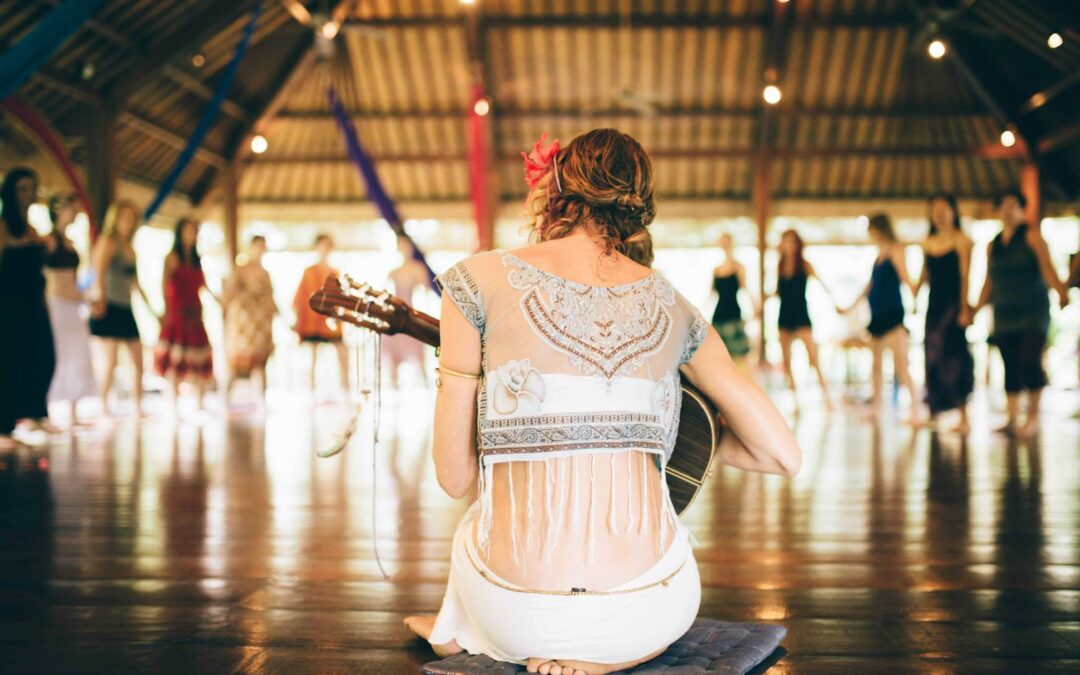
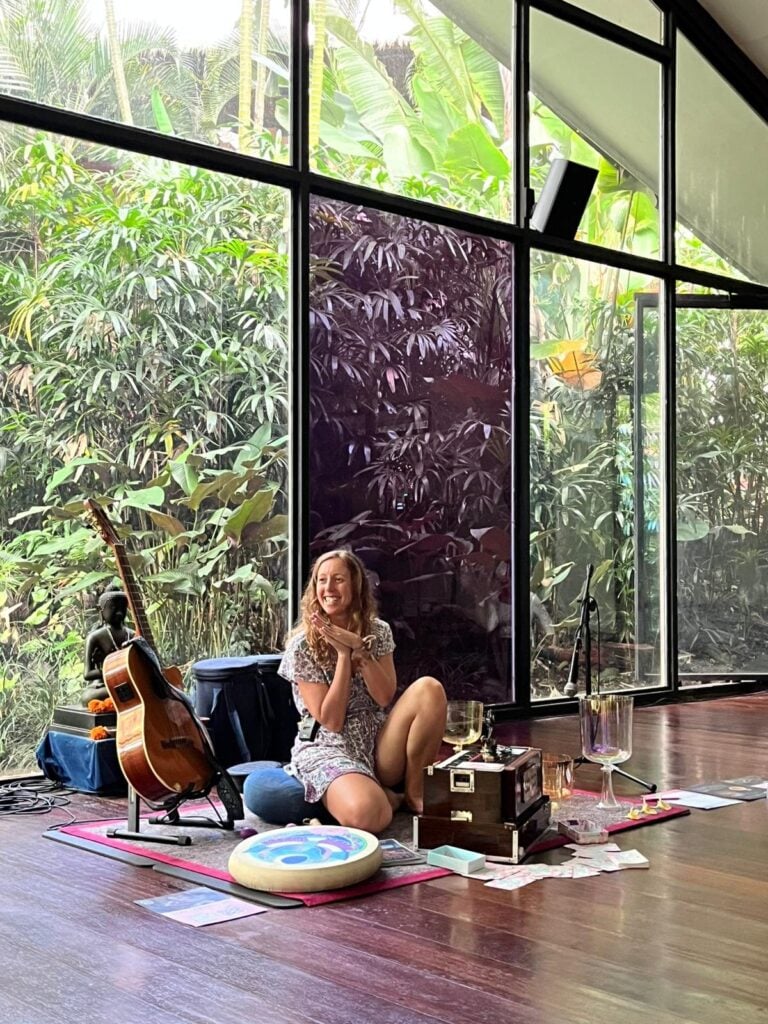
Francie La Flow with her guitar leading a large group in an open-air hall

You hold space for people. Yoga classes, workshops, women’s or men’s groups, retreats, circles of every kind. You’d love to bring singing into the room, and every time you picture yourself starting the first song, a little voice in your head says, “Who am I to lead singing? I’m not a singer.”

By the end of this page you’ll have a simple ten-step flow for your first singing circle, the agreements that help people feel safe to make sound, and a 90-second practice to steady your own voice before you begin.

Try this first (about 90 seconds)

Before your next class, stand with your feet under you and let your jaw soften. Breathe in through your nose and sigh out loud three times. Then hum one low, comfortable note for a whole exhale, and one more. Now sing the first line of a song you love, slowly, starting on that same easy note. That note is home. It’s the note you can lead from.

If you’ve done the trainings and the courses, maybe even a few singing lessons, and you still freeze at the thought of starting a song, that makes so much sense. The insight lives in your head. The block lives in your body. Your own voice needs to feel safe in the room before it can make the room feel safe for anyone else, and that comes from practice, out loud, a little at a time.

I want to gently offer another way to see it, because you can lead a singing circle with the voice you already have.

A singing circle needs someone who holds space and wants to hold it more fully. It needs a warm, steady voice that people can follow, and a leader who makes it safe to sound imperfect. A perfect voice is optional. In fact, a leader who sounds real and relaxed often helps people open up more than a polished one, because nobody feels they have to live up to anything.

Which of these sounds like you?

Almost every new circle leader carries one worry louder than the rest. Pick yours and jump to the step that helps it most.

  • My voice isn’t good enough to lead. Your steadiness matters far more than your range. Start with choosing simple songs.
  • I’m scared nobody will sing back. People sing when they feel safe, and safety is something you can set up. Start with making it safe first.
  • I don’t know how to structure it. A circle has a simple shape you can follow every time. Start with knowing why you’re gathering.
  • I’m worried about using songs from other traditions. Songs travel through people, and you can carry them with care. Start with carrying songs with integrity.

Here’s how I’d guide you to lead your first singing circle, step by step.

1. Know why you’re gathering

Before you choose a single song, get clear on the intention. Is this circle for connection? For devotion? For grief, celebration, the new moon, or the pure joy of singing together?

Your intention shapes everything: the songs, the pace, the words you use to open. It also gives you somewhere to come back to if you feel nervous. Serving the intention is your whole job.

2. Make it safe before you make it musical

This is the heart of it. People’s voices open when their nervous systems feel safe, so safety comes first, every time.

At the start, share a few simple agreements out loud:

  • Nobody has to sing. Listening is participating.
  • Humming counts.
  • There’s no such thing as a wrong note here.
  • We don’t comment on anyone’s voice, only on our own experience.
  • What’s shared in the circle stays in the circle.

You’ll see shoulders drop as you say these. For many people, it’s the first time anyone has told them their voice is welcome exactly as it is.

3. Help people arrive

Give people a moment to land before asking anything of their voices. You might go around and share names and one word for how everyone is feeling. Online, invite people to share in the chat where they’re tuning in from and what they’re bringing today. Some facilitators love to have everyone draw an oracle card as a gentle intention.

Keep it short and light. The goal is for people to feel who’s in the room.

4. Land in the body

Now bring everyone into their bodies with a few deep breaths together, then sigh them out loud, which is often the first sound anyone makes and usually gets a laugh. Hands on hearts. If it suits your circle, three Oms together is a lovely way to blend voices without anyone singing alone.

Francie La Flow smiling beside her guitar in a purple dress with a flower in her hair

5. Warm up the body and the voice

The voice lives in the whole body, so warm up the whole body. Roll the shoulders, massage the jaw, stretch the tongue, pull silly faces, shake everything out. Gentle humming and soft sirens, sliding low to high, wake the voice up without any pressure.

A playful warm-up does something important: it lowers the stakes. When everyone has just made ridiculous faces together, singing a simple song feels easy by comparison.

6. Choose simple songs

For your first circles, choose songs that are:

  • short and repetitive, so people learn them by ear
  • call and response, so nobody has to know the words ahead of time
  • in a comfortable, middle range for most voices
  • songs you know well and love

Mantras and medicine songs work beautifully, as do simple chants in your own language. Teach line by line: you sing a line, the circle sings it back. Repeat each song many times. By the third or fourth round, people stop thinking and start feeling, and that’s often when harmonies start to appear on their own.

If you’re nervous about pitch, start the song on a note that sits easily in your own voice. Your steadiness matters far more than your range.

7. Carry songs with integrity

Songs travel through people. Before you sing, name who carried the song to you, and where it comes from if you know. Take care with songs from Indigenous and ceremonial traditions, and ask whether a song is meant to be shared in the setting you’re holding. Learn the meaning of the words, and do your best with pronunciation.

This matters so much to me that I wrote a whole post about it: The Art of Songcarriers.

8. Let the room co-create

Once people are warm, invite requests. Ask what the room is in the mood for. Let people add harmonies, drums or shakers. The more the circle shapes itself, the more it belongs to everyone.

Francie La Flow smiling with her guitar against a jungle rock wall

9. Make space to share

Near the end, open some space for anyone who wants to share how they’re feeling. Keep it optional, and keep your responses simple. A warm “thank you for sharing” is often all that’s needed. You’re holding space, and holding space means letting people’s experience be theirs, without fixing, analysing or advising.

10. Close with care

Close the way you opened, with intention. Gratitude, a moment of silence, or three final Oms together. Let people leave gently.

The worries almost every new circle leader has

“My voice isn’t good enough.” Your voice only needs to be clear enough to follow. People are listening for warmth and safety far more than technique.

“What if I forget the words?” Keep lyric sheets nearby, or project them online. Forgetting a word and laughing about it gives everyone permission to be imperfect too.

“What if nobody sings?” Start with humming and sighing, which almost everyone will join. Keep singing yourself, steadily and kindly. Voices usually follow once the room warms up.

“What if someone gets emotional?” It happens, because singing opens the heart. Breathe, stay present, keep the song going gently if it feels right, and offer a tissue and a kind glance. Tears in a circle are often a sign of safety.

Your voice is enough to hold the room

The circles that change people are held by leaders who are present, warm and willing to be real. That’s something you can grow into, one circle at a time.

Want a map for your first one? My free Vocal Flow Facilitator’s Blueprint walks you through a whole 60-minute circle, step by step, with two gentle vocal warm-ups, a heart song to share and three essentials for a space that feels safe and sacred. It’s the structure I use myself, and you don’t need to be a singer to lead with it.

You might also enjoy What Happens at a Singing Circle?, which walks through a circle from the participant’s side.

Want to lead your first circle with a flow you can trust?

My free Vocal Flow Facilitator’s Blueprint gives you the whole 60-minute circle, step by step: two gentle warm-ups, a heart song to share and the three essentials for a space that feels safe and sacred.

Send me the Blueprint

Francie La Flow, voice healer and somatic guide

About Francie

Francie La Flow is a voice healer, somatic guide and bhakti musician based in Ubud, Bali. For more than 15 years she has helped people come home to their voices through yoga, sound, singing circles, retreats and 1:1 sessions.
What Happens at a Singing Circle? A Gentle Guide for First-Timers (Even If You Think You Can’t Sing)

What Happens at a Singing Circle? A Gentle Guide for First-Timers (Even If You Think You Can’t Sing)

← Back to Pureflow

What Happens at a Singing Circle? A Gentle Guide for First-Timers (Even If You Think You Can’t Sing)

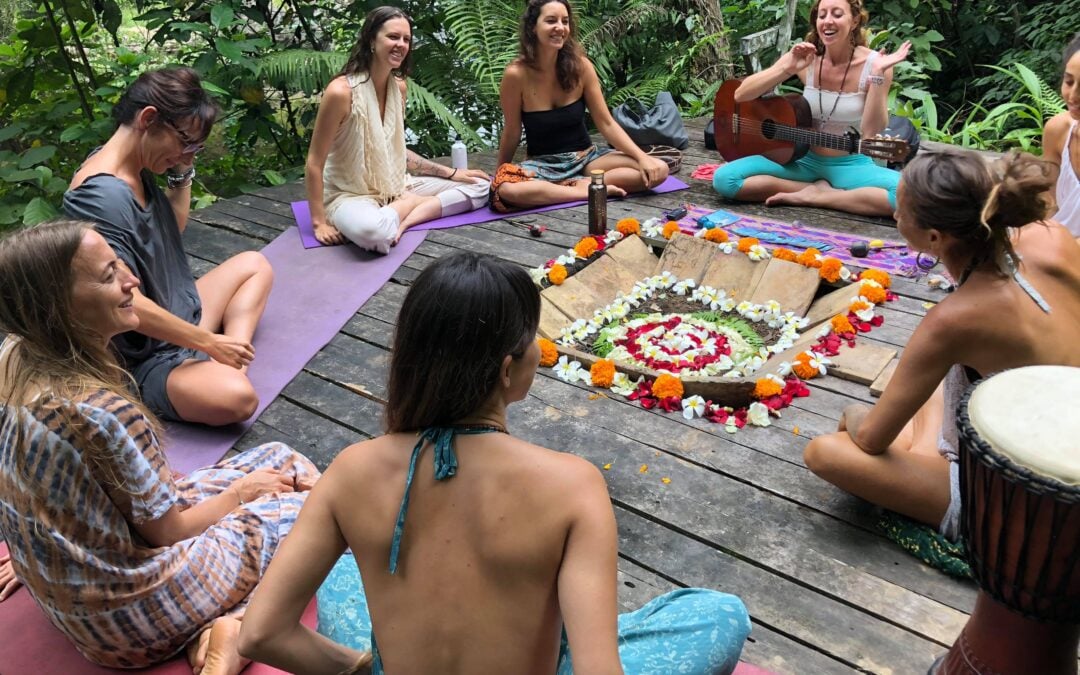
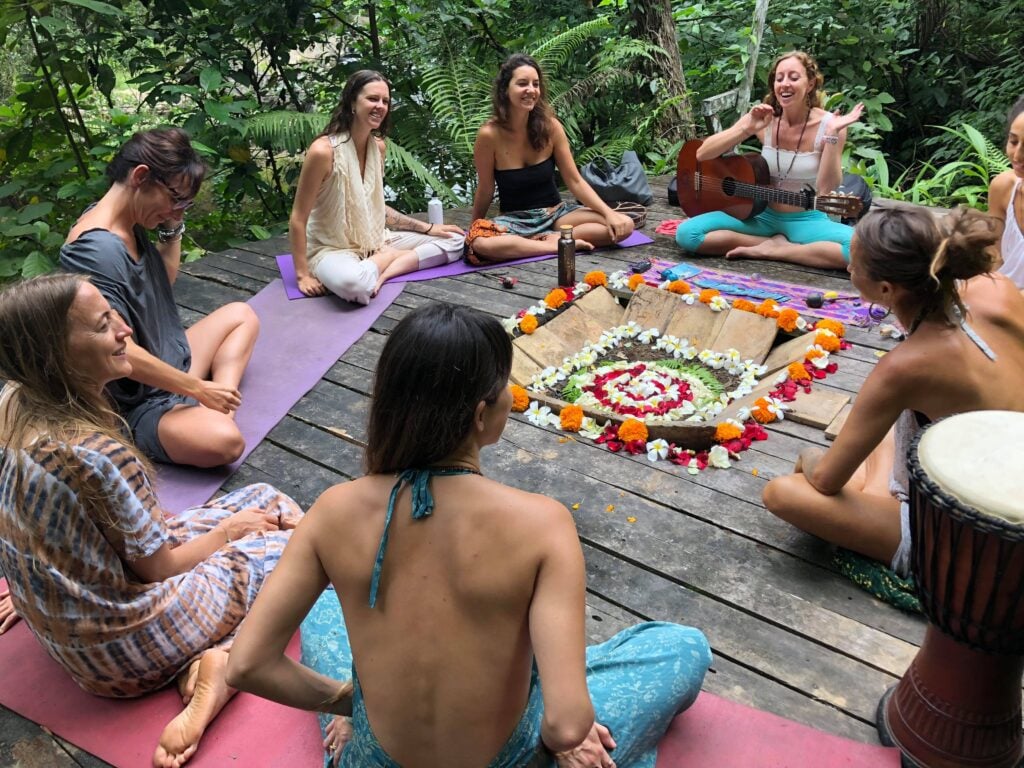
A singing circle gathered on a wooden deck around a flower mandala in the jungle

You love the idea of singing with other people. Then you picture the moment someone smiles and says “Okay, let’s sing!”, your throat tightens, a little voice says “but I can’t sing”, and you’re already planning how to hide at the back…

By the end of this page you’ll know exactly what happens at a singing circle, from the first breath to the last Om, and you’ll have a tiny practice to take with you, so your voice feels a little safer before you walk in.

Try this first (about 90 seconds)

Put one hand on your chest. Breathe in through your nose, then sigh it out loud, a little messy. Do that twice. Now hum one long note, any note at all, and feel it buzz under your hand. Hum three more times. That is exactly how a circle begins, with breath and a hum, and you just did it on your own!

If you’ve sung along in the car for years, been to kirtan, maybe even had a singing lesson or two, and your voice still disappears the moment other people can hear it, nothing is wrong with you. The insight lives in your head. The fear of being heard lives in your body. A circle helps because your body gets to learn, one round at a time, that making sound around other people is safe.

If your stomach just dropped a little, you’re in very good company. So many of the people who end up loving singing circles arrive convinced they can’t sing, sure everyone will hear them, and ready to hide at the back. By the end, a lot of them are singing.

I’ve been holding and singing in circles for years, and I’d love to take the mystery out of it for you. Here’s what happens at a singing circle, what to expect your first time, and why nobody is listening for “good”.

Which of these sounds like you?

Most first-timers arrive with one worry sitting right on top. Pick the one that feels most familiar and jump straight to it.

  • I’m scared I’ll be off-key. Nobody is listening for good in a circle, and your voice blends into everyone else’s. Start with “But I can’t sing”.
  • I go quiet the moment others can hear me. Most circle songs are call and response, so you never sing alone. Start with how the singing works.
  • I don’t know the songs or what I’m supposed to do. You never need to know anything ahead of time. Start with the circle step by step.
  • I’m worried I’ll get emotional. Singing opens the heart sometimes, and there is room for that. Start with what to bring.

What a singing circle is

A singing circle is a group of people who gather to sing together, usually simple, repetitive songs that are easy to learn by ear. There’s no audience and no stage. Everyone faces each other, or faces the same screen, and the whole room is the choir.

Circles go by lots of names: song circles, heartsong circles, voice circles, kirtan, medicine song gatherings. The songs might be mantras in Sanskrit, medicine songs in Spanish, or simple chants in English. The flavour changes from circle to circle, and the heart of it stays the same: people making sound together, and feeling a little more at home in their own voice because of it.

What happens in a circle, step by step

Every circle has its own rhythm. Here’s how the circles I hold usually flow, so you know what you’re walking into.

Arriving

We start by landing in the room together. Online, I invite cameras on if that feels okay, and people share in the chat where in the world they’re tuning in from and what they’re bringing with them today. Sometimes we pick an oracle card as an intention. It’s a simple way to feel who’s here before anyone sings a note.

Landing in the body

Next we come into the body. A few deep breaths, then sighing them out loud, which is often the first sound anyone makes and usually gets a laugh. Then hands on the heart, a dedication, and three Oms together.

Warming up

Then we wake up the body and face, because the voice lives in the whole body. We loosen the jaw, stretch the tongue, shake out the self-consciousness (we actually shake!), and gently tap the head and the heart as a way of giving ourselves permission: permission to rest, permission to feel, permission to take up space. There’s usually a lot of laughter in this part, and I love that, because laughing is one of the quickest ways I know to soften a tight throat.

Singing

Then we sing, usually several songs. Most of them are call and response: I sing a line, you sing it back. You never have to know the words ahead of time, and you never sing alone.

We repeat each song many times, so by the third or fourth round your body starts to know it. That’s often when something lovely happens: people stop thinking about their voice and start feeling the song. Harmonies appear out of nowhere. The sound gets bigger and softer and bigger again.

I also like to take requests, and I often ask the room whether we’re in the mood for Spanish, English or Sanskrit. And before we sing, I name the person who carried the song to me, because songs travel through people and it matters to honour where they came from. I wrote more about that in The Art of Songcarriers.

Sharing and closing

Toward the end there’s space to share, on camera or in the chat, or silently in your own heart. Nobody has to speak. We close with gratitude and three more Oms, and people usually leave a lot lighter than they arrived.

Francie La Flow smiling with her guitar in a garden, wearing a white dress

“But I can’t sing”

I hear this more than anything else, so let’s talk about it.

In a circle, nobody is listening for good. Your voice blends into the group sound, so nobody can pick you out, and everyone is too busy with their own voice to notice yours. If singing feels like too much, hum. Humming counts! You can also just listen for a whole song and join in when your body feels ready.

What I’ve seen again and again is that the voice relaxes when the pressure comes off. When there’s no performance, no solo and no grade, the throat softens, the breath deepens and sound starts to come more easily.

One of my favourite quotes about this comes from Gabor Maté: “Safety is not the absence of threat but the presence of connection.” A circle is connection you can hear.

Why singing together feels so good

When a room full of people sings the same simple song over and over, something shifts. Long phrases lengthen the out-breath, which tends to settle the body. The repetition gives the busy mind something to rest on. And the sense of belonging, of being one voice among many, lets a lot of people feel safe enough to open up in a way they couldn’t on their own.

These are the words I keep coming back to when I think about why I sing in circle:

It is our birthright to sing, to belong to a world where our voices can be seen, heard and held. It is our responsibility to heal, to expand our capacity to give and receive love, to sing each other home, and to bring harmony to the world.
Francie La Flow sitting in a white dress with her arms open and her face lifted to the sky

What to bring to your first circle

  • A bottle of water or a warm tea
  • Something cosy to sit on, and a shawl if you run cold
  • Tissues, just in case, because singing sometimes opens the heart
  • An open mind about your voice, even if it’s only a tiny bit open

If you’re joining online, find a spot where you feel comfortable making sound, and remember you can mute yourself anytime. Some people love singing on mute at first, because they can sing fully without anyone hearing a thing.

How to find a singing circle near you

Yoga studios, community centres, kirtan nights and retreat centres often host circles, so it’s worth asking around or searching “singing circles near me”. Online circles are a beautiful option too, especially if you’d rather start from the comfort of your own home.

I’ve also written about the healing power of singing together in circle, if you’d like to read more.

Want to walk into your first circle already feeling at home in your voice?

Start with my free voice practices: a Permission to Sing meditation, a vocal care ritual and a playlist to sing along with. Nobody hears you but you.

Send me the free practices

Francie La Flow, voice healer and somatic guide

About Francie

Francie La Flow is a voice healer, somatic guide and bhakti musician based in Ubud, Bali. For more than 15 years she has helped people come home to their voices through yoga, sound, singing circles, retreats and 1:1 sessions.
Common Voice Problems, and How to Work With Each One

How to Find Your Authentic Voice as a Teacher, Facilitator or Space Holder

← Back to Pureflow

How to Find Your Authentic Voice as a Teacher, Facilitator or Space Holder

Francie La Flow teaching a Vocal Flow class at The Yoga Barn in Ubud, sitting on the floor beside her guitar

You stand at the front of the room. Maybe it’s a yoga class, a workshop, a women’s circle, a retreat, a team meeting. People are looking at you, waiting for you to begin. You open your mouth and a voice comes out that doesn’t quite feel like yours.

It might be a little higher than your everyday voice. A little faster. A little too careful. Or it sounds exactly like the teacher who trained you, cue for cue.

By the end of this page you’ll know which “teaching voice” you tend to slip into, why it happens, and seven simple practices to find the voice that’s actually yours, so the people in your room feel you, and you feel at home leading them.

Try this first (about 90 seconds)

Sit or stand comfortably and let your jaw hang a little loose. Sigh out loud twice. Now hum on a low, easy note for a whole exhale, and notice where you feel it buzz: chest, throat, face. Take one more breath and speak the first line you usually say to open a class, starting on that same hummed note, slower than feels normal. Something like “Welcome, let’s begin by arriving.” Notice how different that sounds from your usual opener. That’s closer to your own voice.

Here’s the piece most teacher trainings leave out. You can learn every cue, every sequence and every bit of philosophy, and still not sound like yourself, because your voice is run by your nervous system before it’s run by your mind. When part of you is busy protecting you in front of a room, your voice is the first place it shows.

I’ve been teaching since 2008, and most of the people I train are new to teaching or new to using their voice in front of people. I see this every single time. The good news is that your authentic voice is already in there. It mostly needs to feel safe enough to come out.

What “authentic voice” means when you hold space

Your authentic voice is the voice you use when you feel safe enough to be yourself. It has two layers.

  • The sound. Your natural pitch, pace, warmth and volume. The way you sound with a close friend at the kitchen table.
  • The words. What you choose to say, the language you use, the stories you tell, the humour that slips out when you relax.

When both layers line up, people trust you. They may never be able to say why. They just feel that what you say and how you say it match, and their own bodies settle.

Stephen Porges, who developed polyvagal theory, describes the melody of the voice, its warmth and rhythm, as one of the main ways our nervous systems read whether we’re safe. Your room is listening to your tone long before it takes in your instructions.

Which of these sounds like you?

Most of us have a go-to teaching voice, and which one shows up depends on the room, the people in it and how we’re feeling that day. See if you recognise yourself.

  • The borrowed voice. You sound like your teacher, or like “a yoga teacher” in general. Same cadence, same phrases, same sing-song. Start with writing your own cues.
  • The pushed voice. Loud, bright, lots of energy, a little bit performing. You’re working hard to hold the room up. Start with finding your home note.
  • The rushed voice. Fast, filling every gap, worried that silence means you’ve lost them. Start with letting silence do some work.
  • The disappearing voice. Quiet, thin, trailing off at the ends of sentences, hoping nobody notices you. Start with finding your home note.
  • The pleasing voice. Soft, sweet, a little higher, every instruction ending like a question. “Maybe if you’d like you could just…?” Start with landing your sentences.

Each of these is your system doing its best to keep you safe in front of people. The pushed voice is holding ground. The rushed voice wants to get through it. The disappearing voice is going still until it passes. The pleasing voice is keeping everyone happy so you stay connected. They all make sense, and none of them need to be fought.

Why your teaching voice drifts from your real voice

Gabor Maté talks about two needs we’re born with: attachment, being connected and accepted, and authenticity, being true to ourselves. When the two collide, especially when we’re young, we choose attachment every time. We learn to sound the way that keeps us loved.

Leading a room brings all of that right back up. Being seen by a group, being responsible for their experience, maybe being paid by them: of course your body reaches for the voice that has kept you accepted before.

And it doesn’t fully go away with experience. I’ve practiced for years, and my voice still tightens in certain moments, like when I need to name a boundary. What changes is that you notice it sooner, and you know how to come back.

When students expect you to be enlightened

If you teach yoga, meditation, sound or any of the spiritual arts, there’s an extra layer. Students can project an image onto you of how you “should” be: enlightened, calm all the time, perfect in your habits and your choices. It’s so easy to start teaching from that image, and your voice gets careful and polished to match it.

The truth is, you’re human, and so am I. The most trustworthy thing you can do is let your voice be honest about that: what you’re still learning, what you find hard, what you don’t know yet. That honesty gives your students permission to be human too.

Seven practices to find your authentic teaching voice

1. Notice which voice shows up, and when

After your next class or session, take two minutes and jot down: Which voice did I use? When did it change? Who was in the room? Most people find a pattern quickly. Maybe the borrowed voice comes out at the start and your real voice arrives halfway through. Maybe the pleasing voice shows up when someone more experienced is in the room. Awareness comes before change, and this one costs you nothing.

2. Find your home note

Use the 90-second practice above before every class for a week. Hum, find the note that feels easy and buzzy, then speak your opening line from there. Your home note is usually a little lower than the voice you’ve been teaching in. When you speak from it, your breath gets longer and your body tells the room it’s okay to relax.

3. Let silence do some work

Give one instruction. Then stop talking for one full breath. It’ll feel like forever the first few times. For your students it feels like space to actually do what you asked. Pauses also give your own nervous system a moment to catch up, and that’s often when your real voice slips back in.

4. Write your own cues

Pick three cues you say in every class that you inherited from someone else. Write each one down, then rewrite it the way you’d say it to a friend you were helping in your living room. Read both versions out loud. Keep the one that sounds like you, even if it’s less poetic. Especially if it’s less poetic.

5. Land your sentences

Notice whether your instructions end going up, like a question, or settling down. Invitations can still be clear and kind. “Close your eyes, or soften your gaze.” “Take your time here.” Let the end of the sentence come down to rest. You’ll feel more grounded saying it, and the people listening will feel held.

Francie La Flow singing in golden light in Bali

6. Let more of you into the room

Your authentic voice includes your humour, your stories, your quirks and the things you love. If you sing, sing. If you’re funny, let yourself be funny. If something moved you this week, share one line of it. Keep the focus on your students, and let them meet a real person at the front of the room. Record one class and listen back once, kindly, the way you’d listen to a student. Notice the moments you sound most like you.

7. Practice in safe rooms first

Your voice grows where it feels safe. Practice new things with a peer, in a small circle, or with a group that already loves you before you take them to a big workshop. Singing together is one of the fastest ways I know to build this, because when a whole room makes sound, nobody is performing alone and your voice gets to stretch without pressure.

Your voice is how you hold the room

When you lead, people borrow your regulation. If your voice is steady and warm, their bodies take the cue and soften. If your voice is rushed or pushed, they feel that too, even when your words are perfect. That’s why I teach voice to space holders as a leadership skill, right alongside sequencing and philosophy.

It’s a practice you grow into one class at a time. If I can find my voice again after losing it, then so can you.

I’d love to hear which of the five voices you recognised. Send me a message on Instagram @francielaflow and tell me.

Want to lead with a voice that feels like home?

The Vocal Flow Facilitator Training is five days at The Yoga Barn in Ubud for yoga teachers, facilitators and space holders. You’ll work with your own voice first, then learn to hold singing circles and lead with your voice in any room you hold.

See the training

Not ready for a training? My free Vocal Flow Facilitator’s Blueprint walks you through a whole 60-minute singing circle, step by step. You might also enjoy What Happens at a Singing Circle?


Francie La Flow, voice healer and somatic guide

About Francie

Francie La Flow is a voice healer, somatic guide and bhakti musician based in Ubud, Bali. She has been teaching since 2008 and helps people come home to their voices through yoga, sound, singing circles, retreats and 1:1 sessions.

The Vocal Flow Method: A Path to Your Embodied, Empowered Voice

The Vocal Flow Method: A Path to Your Embodied, Empowered Voice

← Back to Pureflow

The Vocal Flow Method: A Path to Your Embodied, Empowered Voice

Francie La Flow reaching toward the light through palm leaves, embodied and free

There is a moment, just before you speak or sing, where everything is decided.

In that split second, your body chooses: flow or hold. Openness or armour. The full, resonant truth of you, or the edited, careful version that feels safer to share.

Most of us live in the edited version. We speak in a voice that is quieter, flatter and more contained than the one we were born with. We hold back in meetings, soften our opinions online, mouth the words at gatherings instead of singing them. And somewhere underneath, there is a quiet ache. A knowing that there is more of us waiting to come through.

The Vocal Flow Method is my answer to that ache. It is a unique methodology for embodied and empowered expression, drawn from over 15 years of guiding voices in circles, retreats and trainings around the world.

Voice, Sound Healing& BhaktiSomatic Integration& CompassionateInquiryYoga &Embodied PracticeFlow Psychology& CreativeExpressionTHE VOCALFLOWMETHOD
  • Voice, Sound Healing & BhaktiVocal activation, mantra, kirtan, harmony and sound bath.
  • Somatic Integration & Compassionate InquiryNervous system work, and trauma aware inquiry trained with Dr Gabor Maté.
  • Yoga & Embodied PracticeAsana, pranayama, meditation and the philosophy underneath.
  • Flow Psychology & Creative ExpressionFlow states, and the Vocal Flow Codes for leading with the voice.
The four disciplines the Vocal Flow Method is built from.

Why the Voice Holds Back

Your voice is one of the most vulnerable parts of you. It is breath, body and emotion made audible. So when life teaches us that being fully heard is risky, the body responds intelligently. The throat tightens. The breath shortens. The volume drops.

This is a nervous system response, and it deserves compassion rather than criticism. Somewhere along the way, many of us absorbed what I call the worthiness wound: the belief that our natural sound, our unpolished truth, is somehow too much or too little. So we learned to edit. To perform. To hold.

The trouble is that what we hold, stagnates. In yogic and healing traditions alike, blocked energy is where dis-ease begins. A held voice costs us more than songs. It costs us aliveness.

If you want to go deeper into the science of this, I’ve written more about it here: Trauma and the Voice: How the Nervous System Speaks Through the Throat.

What Flow Actually Means

Psychologist Mihaly Csikszentmihalyi, who pioneered the research on flow states, described flow as the experience of being so absorbed in what you are doing that the inner critic goes quiet and self-consciousness dissolves. Athletes call it the zone. Musicians call it the pocket. Mystics call it oneness.

In vocal flow, we drop out of the thinking, evaluating mind and merge with the moment itself. The voice moves because it wants to. Sound arises, improvisation happens, and there is a feeling of being sung rather than singing.

This is the heart of the method: experiencing rather than evaluating. When we sing or speak from flow, we release judging, criticising and comparing. We simply meet the sound as it is. And in that meeting, something ancient in us exhales.

The Vocal Flow Method: Three Interwoven Paths

The Vocal Flow Method works at the intersection of psychotherapeutic technique, contemplative practice and pure, embodied joy. Here is how the three paths weave together.

1. Compassionate Inquiry and Somatic Trauma Resolution

Drawing on Dr Gabor Maté’s Compassionate Inquiry approach, we gently explore what is beneath the block. Rather than pushing through tension or forcing a bigger sound, we get curious. What is this tightness protecting? When did the voice first learn to hide?

This somatic, trauma-informed foundation is what makes the method safe for real transformation. We work with the body’s pace, honouring the wisdom of every hold before inviting it to soften. This is how we heal the worthiness wound at its root, rather than papering over it with technique.

2. The Path of Practice

From my background in yoga philosophy comes a simple truth: insight alone changes very little. To wire new circuits in the brain and the body, we practice. Progress lives in repetition.

Just as a daily asana practice slowly reshapes the body, a daily vocal practice slowly reshapes your relationship with expression. Small, consistent moments of free sounding, humming, toning and singing teach your nervous system that it is safe to be heard. Over time, the edited self loosens its grip and the natural voice returns.

3. Joy Cultivation, Mantra and Kirtan

The third path is deliberate joy. Mantra and kirtan are ancient sound practices, both individual and communal, that focus, tame and orient the mind toward positive, uplifting vibration. When we sing sacred sound together in a circle, something happens that solitary practice can rarely touch: we remember that our voices belong together.

Joy is a practice too. It is trainable. And a voice steeped in joy sounds different: warmer, freer, more alive.

Who the Vocal Flow Method Is For

This work is for you if you long for a clearer, more embodied and empowered voice. That might look like:

  • Professionals and leaders who want to speak with grounded confidence in meetings, presentations and high-stakes conversations
  • Teachers, facilitators and healers ready to share their voice in classes, circles and healing spaces
  • Creatives and heart-led entrepreneurs who feel the block most keenly on camera, on social media and online
  • Singers and secret singers reclaiming the pure pleasure of song after years of silence or self-judgement
  • Anyone seeking personal guidance and support to gently unblock whatever is holding back their true expression

The Side Effects of Vocal Flow

Yes, the voice itself changes. People consistently describe their voice becoming more grounded, natural, expressive and beautiful in tone. The sound deepens and warms as the body relaxes around it.

And yet the voice is almost the smallest part of it. The deeper shifts arrive in how you live: speaking your truth with ease, taking up your rightful space, feeling at home in your body, creating and sharing without the exhausting inner editor. Your voice becomes a doorway, and what you walk through into is your own life, fully expressed.

Reclaiming Your Birthright

Here is what I believe with my whole heart: singing and free expression are your birthright. Every culture on Earth has sung. Around every fire, in every field, at every threshold of birth, grief and celebration, human voices have risen together. Somewhere along the way, many of us were told that singing belongs only to the talented. That was a lie.

The goal of vocal flow is beautifully simple: to find the joy in reclaiming that birthright, and to practice living in a natural, unedited, fully expressed way. Out of the mind, into the moment, in love with the sound of your own aliveness.

Your voice is waiting. It has been waiting your whole life. And it will meet you the moment you decide to meet it.

Begin Your Vocal Flow Journey

Curious where your voice is on its journey home? Take the free throat chakra quiz to find which protective voice shows up for you, or download the Vocal Flow Circle Blueprint to bring the magic of shared song into your own community.

Take the Free Throat Chakra Quiz Get the Vocal Flow Circle Blueprint

Francie La Flow, voice healer and somatic guide

About Francie

Francie La Flow is a voice healer, somatic guide, and retreat leader based between Ubud, Bali and Koh Phangan, Thailand. She works at the intersection of somatic movement, voice healing, Compassionate Inquiry, and bhakti practice, drawn from over 15 years of guiding voices in circles, retreats and trainings around the world.

She teaches weekly at The Yoga Barn in Ubud, leads Soul Resonance Retreats in Bali and Thailand, and works with private clients worldwide through 1:1 sessions and her Rising Resonance programme. As a bhakti musician, she brings mantra, medicine songs, and sacred sound into everything she teaches: the voice as instrument, the body as resonance chamber, the song as the path home.

How to Lead a Singing Circle (Even If You Don’t Think of Yourself as a Singer)

Why You Can’t Think Your Way to Authentic Expression (And What Actually Works)

← Back to Pureflow

Why You Can’t Think Your Way to Authentic Expression (And What Actually Works)

I see it happen constantly in sessions. Someone arrives wanting to speak more freely, to stop holding back, to finally say the thing they’ve been unable to say. They’ve read the books. They’ve done the journalling. They understand, intellectually, why they silence themselves.

And yet, when they open their mouth, something still closes.

This is one of the most important things I’ve learned after 15 years of working with voice and the body: you cannot think your way into authentic expression.

Understanding the pattern doesn’t dissolve it. Knowing why you hold back doesn’t free you. The insight lives in your head. The block lives in your body.

The body is not a metaphor

When we talk about voice, we often speak in metaphors. “Finding your voice.” “Speaking your truth.” These are beautiful phrases, but they can mislead us into thinking that authentic expression is primarily a mental or emotional process.

It isn’t.

Your voice lives in your nervous system. It lives in the muscles of your throat, the expansion of your ribcage, the way your diaphragm meets your breath. When you were silenced — as a child, in a relationship, in a room where you learned it wasn’t safe to take up space — your body learned that lesson too.

The body doesn’t forget. It stores those lessons as patterns: a tightening in the chest, a throat that closes before the words come, breath that goes shallow when you need it most.

These aren’t psychological problems. They’re somatic ones. And somatic problems need somatic solutions.

What the mind can and can’t do

Don’t get me wrong. The mind matters. Insight, intention, and understanding all play a role. But they’re the beginning of the journey, not the destination.

You can spend years understanding why you don’t feel safe to speak. That understanding is valuable. But unless you also work with the body — with breath, with sound, with movement — the pattern often stays intact.

I go deeper into the body side of this, including the four ways a voice protects itself, in Trauma and the Voice: Why Your Voice Shuts Down.

This is why so many people who have done significant inner work still feel held back in their expression. They’ve done the mind work. They haven’t yet done the body work.

The somatic path through

What does body-based voice work actually look like?

It starts with breath. Not controlled breathing, but felt breathing — learning to notice where your breath moves freely and where it gets stuck. The breath is the foundation of the voice. You cannot have an open, free voice when your breath is held.

From there, we move into sound. Not performance — just sound. Humming. Toning. Finding vibration in the chest, the throat, the skull. These vibrations literally massage the nervous system. They activate the vagus nerve, shifting the body from a state of protection into a state of safety.

And from safety, expression becomes possible.

This is the sequence: safety in the body, breath opens, sound opens, expression flows.

No amount of thinking can shortcut this sequence. But ten minutes of conscious voice and body work can shift it profoundly.

Two-minute quiz

Which voice shows up for you when it matters? Ten quick questions show your protective voice, what it does to your breath, jaw and throat, and the practice that helps it first.

Take the throat chakra quiz

What this means for you

If you’ve been trying to think your way to more authentic expression — through journalling, through reading, through analysis — I want you to know: you’re not doing it wrong. You’re just doing the first layer.

The next layer is the body.

The next layer is sound.

The next layer is actually making the sound you’ve been afraid to make, in a space that feels safe enough to let it out.

That’s what this work is. Not performance, not technique — just the gentle, patient, deeply effective process of befriending your own voice.

If you’re ready to try it, start right now. Hum. Just for a moment. Feel it in your chest.

That’s where it begins.


Francie La Flow is a voice healer, somatic guide, and retreat leader based in Ubud, Bali. She works with people worldwide through 1:1 sessions, online programs, and immersive retreats in Bali and Thailand.